It’s that time again. The new year hits, and your social feeds and inbox fill up with a familiar frenzy. “This is YOUR year!” “Hit six figures by June with affiliate marketing!” “Follow my simple blueprint!” It’s intoxicating. You feel that surge of motivation, that “this time will be different” conviction. You pick a niche, maybe sign up for a course, and jump in with both feet.
And then, by March or April, the silence is deafening. A trickle of clicks, maybe a sale or two, but mostly… crickets. That shiny new website feels like a ghost town. The excitement fades, replaced by the nagging thought: “What am I doing wrong? Why is this not working for me when it seems to work for everyone else?”
Here’s the hard truth most gurus won’t tell you around New Year’s: Most people fail at affiliate marketing not because of a secret tactic they missed, but because of a foundational mindset they never built. They chase the “what” and ignore the “who” and the “why.” This year, let’s break that cycle. Let’s talk about why most people stumble right out of the gate and, more importantly, how you can plant your feet on solid ground instead.
The Three Poison Pills of January Motivation
Every January, a wave of new affiliate marketers takes the same three poison pills that guarantee burnout by spring. Recognizing them is your first step to immunity.
Poison Pill #1: The “Niche-by-Numbers” Trap. This is when you pick a niche not because you care about it, but because a spreadsheet or a guru told you it has “high ticket items” and “low competition.” You end up trying to sell premium espresso machines when you drink instant coffee, or promote high-end photography gear using a smartphone camera. Your content lacks passion, insight, and authentic curiosity. Your audience can smell the disconnect a mile away. You’re not a guide; you’re a billboard, and people scroll past billboards.
Poison Pill #2: The “Shiny Object Syndrome” Sprint. You start strong, publishing five blog posts a week and ten social media videos. You’re following three different “proven” strategies at once. But this pace is born from frenzy, not from strategy or sustainability. It’s a sprint, and you’re not training for a marathon. By February, you’re exhausted. The well of ideas is dry because you never gave yourself time to refill it through learning and living. Burnout isn’t a badge of honor; it’s a sign you built on a shaky foundation.
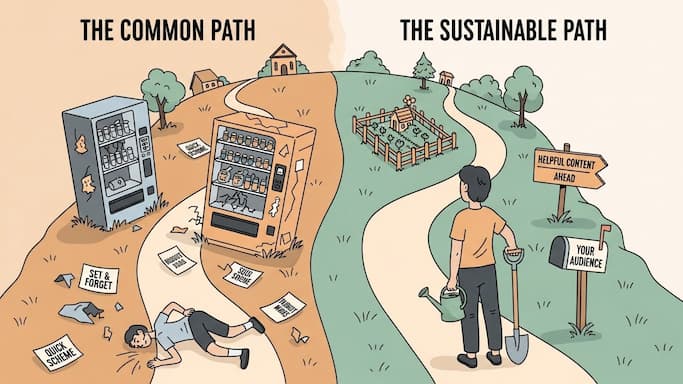
Poison Pill #3: The “Set-it-and-Forget-it” Fantasy. This is the belief that you can write a few reviews, paste your affiliate links, and the commissions will just roll in. You treat your website like a vending machine: insert content, get money. But the online world doesn’t work like that. It’s a community garden. It requires consistent tending, conversation, updating, and genuine help. Google’s algorithms change. Products get updated or discontinued. New questions emerge. If you’re not there to tend the garden, it gets overgrown and forgotten.
The Antidote: Building a Platform, Not Just Posting Links
The successful affiliate marketers you see—the ones who have consistent, growing income—aren’t just marketers. They are publishers, educators, and trusted guides. Their affiliate revenue is a byproduct of the real service they provide. This is the core mindset shift. You are not in the business of selling other people’s products. You are in the business of solving a specific problem for a specific person. The products are simply the best tools you’ve found to help them do that.
Think of it like this: If you needed heart surgery, you wouldn’t trust a billboard that said “Buy This Scalpel!” You’d find the most reputable, experienced heart surgeon. That surgeon’s authority and trust come first; the specific tools they recommend (and may earn a fee for using) are a secondary result of their deep expertise. Your goal is to become the “surgeon” for your niche—the trusted authority.
Your “Avoid the Failure Trap” Action Plan
So, how do you build that authority and avoid the common pitfalls? It comes down to three focused commitments.
Commitment #1: Choose a Niche You Can Actually Talk About, Not Just Profit From. Your niche should be at the intersection of something you have real experience in (or a burning desire to learn) and a problem people will pay to solve. Ask yourself: “Can I create 100 pieces of content about this without wanting to scream?” If the answer is no, it’s too narrow or you’re not passionate enough. Your genuine interest is the fuel that will keep you going long after New Year’s motivation fades.
Commitment #2: Master the “Beginner’s Mind” Content. Most failed marketers try to sound like an expert on day one. The successful ones do the opposite. They document their journey. They ask the “dumb” questions their audience is too embarrassed to ask. “Here’s exactly how I set up my first home coffee station for under $200.” “These are the three budget lenses I tried as a photography newbie, and here’s what happened.” This is incredibly powerful. It builds relatability and trust. You’re not a distant expert; you’re a helpful friend a few steps ahead on the path, pointing out the potholes.
Commitment #3: Prioritize Building an Asset, Not Just Chasing a Commission. Your website and your email list are your only true assets. Social media platforms are rented land; they can change the rules or vanish overnight. Focus on creating cornerstone content on your own site—definitive guides, detailed tutorials, heartfelt reviews—that brings people in from search engines and social media. Offer a simple, valuable lead magnet (like a checklist or a comparison PDF) to capture their email. Now you have a direct line to your audience, forever. You can send them updates, new recommendations, and deeper help. This asset grows in value every single day, independent of any algorithm.
This Year Can Be Different (But Not for the Reasons You Think)
This new year doesn’t need a new “hack.” It needs a new perspective. The goal isn’t a quick commission. The goal is to become a trusted voice for a group of people you enjoy serving.
Forget the pressure of “six figures by June.” Focus on this: “By June, I will have published 25 truly helpful pieces of content and built an email list of 100 people who trust my advice.” That is a measurable, achievable goal that builds a real foundation. The first sale from that foundation will feel different—it won’t be luck, it will be proof that your system is working.
Stop preparing for a sprint no one can win. Start training for a marathon you can actually finish—and enjoy. Lace up your shoes, pick a path you’re curious about, and start walking. This time, build something that lasts all year long.