



Let’s cut right to the chase. You want to start freelancing. You’ve probably dreamed about the freedom, the flexible schedule, and the idea of getting paid for work you actually control. But then reality hits. Your resume doesn’t scream “freelancer.” Your portfolio is, well, non-existent. That little voice in your head whispers, “Who’s going to pay me? I have no experience.”
I’m here to tell you that voice is wrong. In today’s world, “experience” isn’t just a list of past job titles on a LinkedIn profile. It’s the skills you use to solve problems, the knowledge you’ve accumulated, and your ability to get things done. Starting freelancing with no traditional experience isn’t a barrier; it’s your starting point. The secret isn’t waiting for permission or a magical credential. It’s about strategically demonstrating your value before you even have a paying client. Let’s reframe the game and get you your first project.
The Mindset Flip: You’re Not “Unemployed,” You’re a Business of One
Before you write a single line of a profile or send a single email, you need to shift your thinking. You are no longer an employee seeking a job. You are a service-based business seeking a client. This changes everything.
As an employee, you trade time for money, and your past job titles are your primary currency. As a freelancer, you trade results for money. Your currency is the specific problem you solve for a specific type of person. Your focus shifts from “my experience” to “their outcome.” When you make this mental switch, you stop asking, “Will they hire me?” and start asking, “What do they need done, and how can I prove I can do it?” This is the foundation everything else is built on.
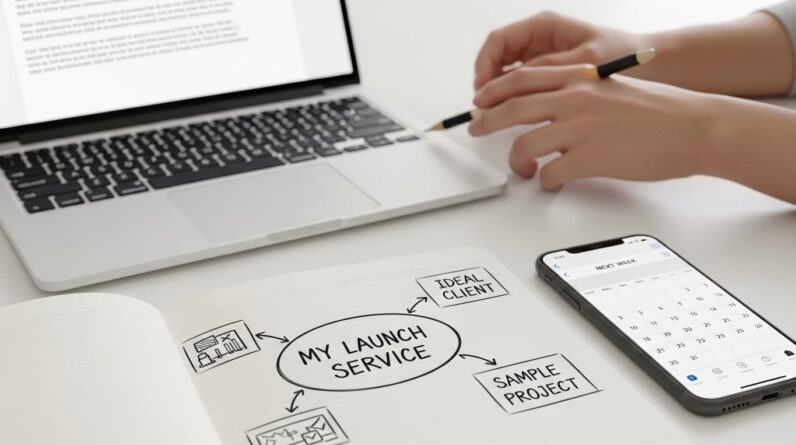
Your First, Most Critical Task: Define Your “Launch Service”
Trying to be a “writer” or a “designer” is too broad and puts you in competition with everyone. You need to get specific. Your goal is to find a narrow lane where you can quickly become a known problem-solver.
Start by auditing your own history. Have you always been the friend who fixes everyone’s resume? Did you organize a successful fundraiser for your kid’s school? Do you have a knack for explaining complex tech to your grandparents? These aren’t just hobbies—they’re signals of a marketable skill.
Combine that skill with a specific industry and a clear deliverable. For example:
-
Don’t say “I’m a writer.” Say, “I help eco-friendly skincare brands write clear, compelling product descriptions for their websites.”
-
Don’t say “I’m a virtual assistant.” Say, “I help overwhelmed podcasters schedule their guest interviews and manage their show notes.”
-
Don’t say “I’m good at Excel.” Say, “I help local restaurant owners set up simple inventory tracking spreadsheets to reduce food waste.”
This specificity does two powerful things: it makes you instantly more memorable to the right people, and it gives you a clear direction for your next steps. You know exactly who to talk to and what to offer.
Building Proof Without a Paid Portfolio
Here’s the part that feels like a catch-22: clients want to see proof, but you need a client to get proof. The way out is to create your own proof. You don’t need a client’s permission to demonstrate your skills.
If your chosen launch service is writing website copy for small yoga studios, you don’t wait for a studio to hire you. You do the work pro-actively.
-
Find 3-5 local yoga studio websites.
-
Analyze their “About” or “Services” pages.
-
Pick one and rewrite a page of their copy as a “speculative sample.” Make it better—more welcoming, more clear about their unique vibe.
-
This sample is now the centerpiece of your portfolio.
This applies to almost any field. A graphic designer can create a sample brand guide for a made-up coffee shop. A social media manager can mock up a week’s worth of posts for a local bookstore. This work shows initiative, skill, and exactly how you think. It transforms you from “someone with no experience” to “someone who understands my business and has ideas.”
The Two-Pronged Attack: Where to Find Your First Client
Sitting on job boards refreshing your feed is a recipe for despair and low-ball offers. You need a proactive, two-part strategy.
The Warm Outreach Method (The Direct Path)
This is where you use your defined niche. Make a list of 20-30 ideal potential clients—the yoga studios, the podcasters, the restaurant owners. Then, craft a short, personal email or LinkedIn message. Do NOT lead with “I’m looking for work.” Lead with value.
The structure:
-
Subject: Quick idea for [Their Business Name]
-
Opening: A genuine, specific compliment about something they’ve done. “I really enjoyed the calming tone of your studio’s website.”
-
The Hook: Present your speculative sample. “As I was browsing, I had an idea for how the ‘About Us’ page could connect even more with new students. I took a stab at rewriting it to show you what I mean. No obligation at all—just an idea.”
-
The Soft Ask: “If this is the kind of thinking that could be useful, I’d be happy to chat for 15 minutes about how I could help with your website content.”
This approach is fearless, helpful, and bypasses the “portfolio” question entirely by providing it on the spot.
The Attraction Method (The Long Game)
While you’re doing direct outreach, you also need to plant seeds publicly. Create one single, valuable piece of content that speaks directly to your ideal client’s problems and publish it where they might see it.
If you want to help podcasters, write a detailed post on LinkedIn titled “The 3 Most Common Mistakes I See in Podcast Show Notes (And How to Fix Them).” If you’re targeting restaurant owners, create a simple infographic about weekly inventory checks and share it in a local restaurant Facebook group. This does three things: it builds your confidence, it demonstrates your expertise publicly, and it makes you discoverable. Someone might read your post and think, “This person gets it,” and reach out to you.
How to Talk Price When You’re Starting Out
Pricing terrifies new freelancers. Do not, under any circumstances, say “I don’t know, what’s your budget?” You are the professional proposing a solution.
For your first few projects, I recommend project-based pricing. It’s cleaner for the client and ensures you get paid for the outcome, not just the hours (which will be many at first). To figure out a number:
-
Define the exact scope: “I will deliver three rewritten website pages: Home, About, and Services.”
-
Estimate how many hours it will take you (be honest, then add 30%).
-
Decide on an hourly rate you’d be thrilled with for a first project (even $25-$40/hr is a fantastic start).
-
Multiply hours by rate. That’s your project fee. Present it as “The investment for this project is $X.”
This feels professional and confident. You can always offer a small “just getting started” discount if it feels right, but always lead with the value of the professional price.
Your Launch Checklist for This Week
The biggest mistake is planning forever. Action creates clarity. Your mission is not to be ready, but to get started.
-
By Friday, define your Launch Service. Get it down to one sentence: “I help [specific client] achieve [specific result] by [your specific service].”
-
Create one portfolio sample for that niche. Spend 3-4 hours making it excellent.
-
Make your list of 10 ideal clients. Find their names and contact info.
-
Draft your outreach email template. Personalize it for the first two people on your list.
-
Set a goal to send two emails next Monday morning.
That’s it. You don’t need a fancy website. You don’t need business cards. You need a clear offer, proof you can do it, and the courage to tell one person about it. Your first client isn’t looking for decades of experience. They’re looking for someone who understands their problem and seems capable of solving it. That someone can be you. Start this week.


