



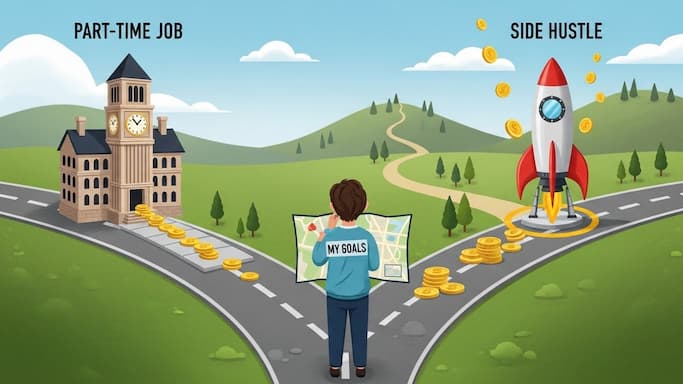
So, you’re ready to make some extra money. The dream is clear: more cash in your pocket each month. But the path to get there? That’s where you get stuck staring at a fork in the road.
On one side, there’s the classic, reliable route: the part-time job. You know the deal—set hours, a predictable paycheck, and a manager telling you what to do. It’s familiar territory.
On the other side, there’s the exciting, modern trail: the side hustle. It’s all over social media—the promise of building something of your own, on your own terms, with sky’s-the-limit potential.
Which one is actually right for you right now? This isn’t about which is objectively “better.” It’s about which is the smarter tool for your specific life, goals, and personality. Picking the wrong one can leave you burned out, broke, or just plain bored.
Let’s cut through the hype and the fear. Think of this not as a permanent career choice, but as a strategic decision for this season of your life. We’ll lay out the real pros, the hidden cons, and the key questions you need to ask yourself so you can stop deliberating and start earning.
The Part-Time Job: The Steady Engine
A part-time job is essentially a scaled-down version of traditional employment. You trade your hours for a fixed wage, on a schedule set by someone else. Think retail associate, server, barista, administrative assistant, or bank teller working 15-25 hours a week.
The Superpowers of “The Engine”:
Its greatest strength is predictability. You know exactly when you’ll work, how much you’ll make per hour, and when that direct deposit will hit your account. This is invaluable if your primary goal is covering a specific, recurring shortfall in your budget, like a car payment or utility bill. There’s also a beautiful simplicity to it. You show up, you do the defined tasks, you leave. The mental load is lighter because the systems, the marketing, and the customer acquisition are all handled by the business. You’re just executing. For many, this separation between “work time” and “my time” is a crucial form of stress relief.
The Hidden Speed Bumps:
That predictability comes with a cost: a hard ceiling on your earning potential. You cannot make more than (your hourly wage) x (the hours they give you). Want to earn an extra $200 this week? Unless you can pick up an extra shift (and they have one), it’s impossible. Your time is literally commoditized. There’s also the issue of schedule rigidity. Your life must bend around the job’s needs, which can clash with family time, spontaneous events, or other personal commitments. Finally, the work itself is often not building a specific, transferable skill asset for you. You’re gaining general work experience, but you’re not necessarily building a portfolio, a client list, or a personal brand that you own.
The Side Hustle: The Custom-Built Rocket
A side hustle is a small business you run on the side of your main gig. You are the CEO, marketer, sales team, and product developer. It’s your creation. Examples include freelance writing or graphic design, selling handmade goods on Etsy, driving for a rideshare service, tutoring online, managing social media for small businesses, or creating a niche blog or YouTube channel.
The Superpowers of “The Rocket”:
The most intoxicating advantage is unlimited upside. Your income isn’t tied to hours; it’s tied to the value you create and how efficiently you can deliver it. A freelance web designer might charge $750 for a project that takes 10 hours of work—that’s a $75/hour effective rate, far above most part-time wages. Then there’s autonomy and flexibility. You decide when, where, and how you work. Need to take a Tuesday afternoon off? You don’t ask for permission, you just manage your client deadlines. Crucially, a side hustle builds equity in yourself. Every client project adds to your portfolio. Every product sold builds your reviews. You are constructing a tangible asset—your own business reputation—that can grow in value over time.
The Hidden Speed Bumps:
Let’s be blunt: the early stages of a side hustle are an emotional rollercoaster with no guaranteed payout. That “unlimited upside” also means “unlimited downside”—you might spend 20 hours building a service no one buys. Income is deeply inconsistent. One month you might land a big client; the next three could be crickets. This requires a different kind of financial discipline. You also carry the full cognitive load. You are responsible for everything: finding clients, setting prices, invoicing, dealing with difficult customers, and handling your own taxes. The freedom is real, but so is the pressure of being the one ultimately responsible for making it work.
The Decision Matrix: Which Path Fits Your Life Right Now?
Don’t choose based on a trending TikTok. Choose based on a clear-eyed look at your current reality. Ask yourself these three questions.
Question 1: What’s My Primary Financial Goal?
Is it to cover a known, fixed expense with reliable cash flow? (e.g., “I need a steady $400 every month for student loans”). If yes, the predictable nature of a part-time job is likely your best fit. It’s a plug-and-play solution.
Or, is it to generate as much extra income as possible and build long-term earning potential, even if it’s bumpy at first? (e.g., “I want to save for a down payment aggressively” or “I want to eventually replace my full-time income”). If yes, the scalable potential of a side hustle is the strategic choice.
Question 2: What’s My Tolerance for Risk and Uncertainty?
Be honest with yourself. Does the thought of not knowing exactly how much you’ll make next month keep you up at night? Do you crave the peace of mind that comes from a set schedule? If so, the structure of a part-time job will serve your mental health better.
Conversely, do you get energized by a challenge? Are you self-motivated and comfortable with the idea that your effort directly dictates your reward, even if it’s not linear? Then you have the entrepreneurial spark that makes a side hustle not just bearable, but exciting.
Question 3: What Am I Willing to Trade: Time or Brain Space?
A part-time job primarily trades your time and physical/mental presence during set blocks. When you clock out, you’re (mostly) free.
A side hustle trades continuous brain space and proactive energy. You’ll be thinking about marketing ideas in the shower, answering client emails after dinner, and plotting your strategy on weekend walks. It’s less about “hours worked” and more about “mental engagement.”
The Hybrid Hack: The Best of Both Worlds?
For some, the answer isn’t a strict either/or. It’s a staged approach or a hybrid model. You might start with a part-time job to establish a baseline of reliable income and reduce financial panic. This stability then gives you the mental breathing room to launch a side hustle on evenings and weekends without desperation. Once the side hustle consistently matches your part-time income, you can quit the job and go all-in on your hustle.
Another hybrid is choosing a “side hustle” that has some “job-like” qualities. For instance, driving for a rideshare or delivering groceries offers more flexibility than a retail schedule, but the pay is still directly tied to your hours logged. It’s a middle ground.
Your Next Move: From Thinking to Doing
The worst thing you can do is let analysis paralysis keep you from moving forward. Money isn’t made in the deliberation; it’s made in the action.
If you’re leaning toward a part-time job, your next step is clean and simple: Polish your resume and start applying to local businesses or flexible remote positions that fit your weekly availability. Start within the next 48 hours.
If you’re leaning toward a side hustle, your next step is about focused creation: Define your one core service or product. Create a single, excellent sample (a writing piece, a design mock-up, three product prototypes). Then, tell three people you know what you’re offering. Don’t build a whole website; build your first proof point.
Both paths are valid. Both require work. The “right” choice is the one that aligns with your current financial needs, your personal wiring, and the season of life you’re in. Choose your adventure, then take the first step. Your future weekend paycheck is waiting.


