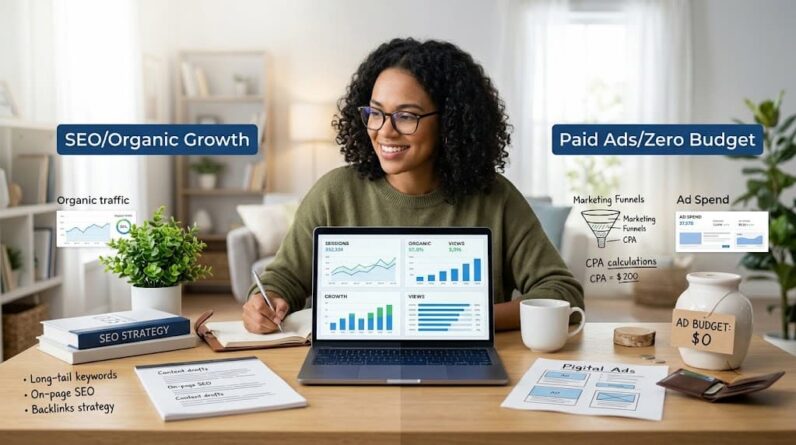
If you’ve ever started a website, blog, or online business, you’ve probably heard the same advice repeatedly: “Invest in SEO” or “Run paid ads to grow faster.” While both strategies can be incredibly effective, there’s one problem many beginners face—they simply don’t have a marketing budget.
That was the starting point for this experiment.
Instead of choosing between search engine optimization (SEO) and paid advertising, I wanted to answer a different question: What can someone realistically learn about both without spending any money? Could free SEO techniques generate meaningful traffic? Is it possible to understand paid advertising without actually paying for campaigns? More importantly, which approach offers the best value for someone starting from scratch?
Going into this challenge, I knew the playing field wasn’t equal. SEO naturally allows free organic traffic if you’re willing to invest time, while paid advertising is designed around spending money. Still, I suspected there were valuable lessons hidden inside both approaches—even on a zero-dollar budget.
The goal wasn’t to prove that paid ads are unnecessary or that SEO works instantly. Instead, it was to understand the strengths, weaknesses, and learning opportunities each strategy provides when financial resources are limited. Along the way, I discovered that some of the biggest advantages had nothing to do with spending money at all. They came from learning how search engines work, understanding user intent, improving content quality, and developing marketing skills that remain valuable regardless of budget.
If you’re a beginner wondering whether to focus on SEO, paid ads, or both, this article walks through the experiment, explains what worked, what didn’t, and highlights practical lessons you can apply to your own website without opening your wallet.
Why I Decided to Test SEO and Paid Ads Without Spending Money
When you’re just starting a blog or website, every dollar matters. It’s easy to find advice saying you should “just run Google Ads” or “hire an SEO expert,” but that advice isn’t always practical for beginners. Many new creators are students, side hustlers, freelancers, or entrepreneurs who simply don’t have hundreds—or even thousands—of dollars to invest in marketing.
That reality inspired this experiment. Instead of asking which strategy produces the biggest results with a large budget, I wanted to know what someone with absolutely no marketing budget could realistically accomplish. Could free SEO techniques bring visitors from search engines? Could I still learn valuable advertising skills without paying for clicks? And perhaps most importantly, where should a beginner invest their time?
One thing became clear almost immediately: time becomes your currency when money isn’t available. Without a budget, every improvement requires research, writing, testing, and patience. Rather than purchasing traffic, you earn it by creating useful content and improving your website little by little.
Another reason for this challenge was to avoid common beginner mistakes. Many new website owners spend money on ads before they understand their audience, optimize their landing pages, or publish quality content. Even if those ads generate visitors, poor preparation often leads to disappointing results.
This experiment wasn’t about finding shortcuts. It was about understanding the fundamentals first. Learning how search engines rank content, how users search online, and how advertising platforms operate creates skills that remain valuable whether your future marketing budget is $0 or $10,000.
The biggest lesson before even beginning was simple: a limited budget doesn’t have to limit your education. There are countless free resources, tools, and opportunities to develop digital marketing skills—you simply need curiosity and consistency.
The Challenge: Growing Traffic on a Zero Budget
Growing website traffic without spending money is both exciting and frustrating. Unlike paid advertising, where visitors can begin arriving almost immediately after launching a campaign, organic growth through SEO requires patience. Search engines need time to discover, index, and evaluate new content before rewarding it with higher rankings.
The first challenge was deciding where to focus my limited resources. Since money wasn’t available, every hour had to count. Instead of trying dozens of different marketing tactics, I concentrated on activities with long-term value: keyword research, content creation, technical improvements, and learning how search engines interpret websites.
I also accepted an important reality: results would probably be slow. Many beginners give up after publishing a handful of articles because they expect immediate traffic. In reality, SEO often takes several months before meaningful progress becomes visible, especially for brand-new websites.
Another obstacle involved avoiding distractions. Social media algorithms, viral trends, and countless marketing “hacks” promise instant success. Instead of chasing every new tactic, I focused on building a solid foundation that could continue producing traffic over time.
The biggest challenges included:
- No advertising budget.
- Limited website authority.
- No existing audience.
- Strong competition for popular keywords.
- Slow search engine indexing.
- Learning everything from free resources.
Despite these limitations, there were also advantages. Working with a zero-dollar budget encouraged careful decision-making, forced me to prioritize high-value activities, and helped me understand the importance of creating genuinely useful content instead of relying on paid promotion.
The experience quickly proved that while money can accelerate growth, it cannot replace strong content, good user experience, and a willingness to learn. Those fundamentals remain essential regardless of how much you eventually spend on marketing.
SEO vs. Paid Ads: What I Learned
After spending time exploring both approaches, the biggest takeaway was that SEO and paid ads are not rivals—they solve different problems. Before the experiment, I thought I would end up declaring one strategy the clear winner. Instead, I realized the better question isn’t “Which is better?” but “Which is better for your current situation?”
SEO rewards patience. Every article, optimization, and internal link contributes to a foundation that can continue generating traffic long after the work is completed. The trade-off is that results rarely appear overnight. It may take weeks or months before search engines recognize a new website as a reliable source of information.
Paid advertising, on the other hand, emphasizes speed. If you have a well-designed landing page, understand your audience, and allocate an appropriate budget, ads can begin sending visitors almost immediately. The downside is that traffic generally stops when the advertising budget ends.
The experiment also showed that success with either strategy depends on the quality of your website. Even the best advertisement cannot fix poor content, and excellent content alone won’t necessarily rank without proper optimization and user experience.
Some of the biggest lessons included:
- SEO requires time but can provide lasting value.
- Paid ads offer faster visibility but require ongoing investment.
- Understanding user intent is essential for both.
- Content quality matters regardless of traffic source.
- Learning fundamentals before spending money reduces costly mistakes.
| Comparison | SEO | Paid Ads |
|---|---|---|
| Speed | Slow to build | Fast results |
| Cost | Time investment | Financial investment |
| Long-Term Value | Excellent | Depends on continued spending |
| Learning Curve | Moderate | Moderate to Advanced |
| Best for Beginners | Yes | Better after learning the basics |
The experience convinced me that beginners shouldn’t feel pressured to choose one forever. Instead, learning SEO first often creates a stronger foundation, while understanding paid advertising prepares you to accelerate growth when your budget eventually allows.
Traffic, Speed, and Long-Term Growth
One of the clearest differences between SEO and paid advertising is how they generate traffic over time.
Paid advertising is like turning on a faucet. Once campaigns begin, visitors can start arriving almost immediately. Increase the budget, and traffic often increases as well. Reduce or pause spending, and the flow usually slows or stops.
SEO behaves more like planting a tree. In the beginning, progress feels slow because you’re preparing the soil, planting seeds, and waiting for growth. There may be little visible change for weeks or even months. However, once articles begin ranking, they can continue attracting readers with relatively little additional investment beyond updates and maintenance.
This long-term perspective changed how I viewed website growth. Rather than chasing immediate numbers, I began thinking about creating content that could remain useful for years. Evergreen articles answering common questions often have the potential to generate consistent organic traffic long after publication.
Another important lesson involved compounding results. Each new SEO article increases the number of opportunities for users to discover your website. As your content library expands, your overall visibility may grow as well.
Traffic characteristics:
- SEO: Slow start, long-lasting potential.
- Paid Ads: Fast start, budget-dependent.
- SEO: Builds authority over time.
- Paid Ads: Builds immediate exposure.
The ideal approach for many established businesses is combining both strategies—using paid ads for immediate visibility while SEO steadily builds sustainable organic traffic. For beginners with limited resources, however, focusing on SEO often provides the greatest long-term return on invested time.
Which Strategy Is Better for Beginners?
After completing this experiment, my answer is more balanced than it would have been before I started. If you’re a beginner with little or no marketing budget, SEO is generally the better place to begin—not because paid advertising isn’t effective, but because SEO teaches the fundamentals of online marketing while building long-term assets.
Writing articles, researching keywords, understanding search intent, improving user experience, and organizing a website are skills that remain valuable no matter how your business grows. These abilities also make future paid advertising campaigns more effective because you’ll already have strong landing pages and useful content for visitors.
Paid advertising becomes more valuable when you already know what works. If you’ve identified content that attracts readers, understand your audience, and know which pages convert visitors into subscribers or customers, advertising can help accelerate growth. Without that knowledge, beginners often spend money testing ideas that could have been validated organically first.
That doesn’t mean beginners should ignore paid advertising entirely. Learning how advertising platforms operate, studying successful campaigns, and practicing campaign planning without spending money are all worthwhile investments of time.
Here’s a simple comparison for beginners:
| Situation | Recommended Focus |
|---|---|
| Brand-new website | SEO |
| No marketing budget | SEO |
| Learning digital marketing | SEO + Ad education |
| Proven product or service | SEO + Paid Ads |
| Need immediate traffic | Paid Ads (with budget) |
| Long-term growth | SEO |
The key lesson is that the best strategy depends on your current stage, not on which marketing channel is more popular.
Practical Lessons for New Website Owners
This experiment taught me much more than how SEO and paid ads differ. It changed how I think about building a website from the ground up. The biggest realization was that sustainable growth rarely comes from shortcuts. It comes from creating value consistently.
One practical lesson was to stop chasing every new marketing trend. There will always be a new platform, algorithm update, or “secret strategy” promising instant results. Instead of constantly switching directions, focus on mastering the basics first.
Another important lesson involved measurement. Instead of checking traffic every hour, pay attention to meaningful indicators like search impressions, click-through rates, keyword rankings, and user engagement. These metrics often show progress before large traffic increases appear.
Patience also proved essential. SEO rewards consistency far more than intensity. Publishing one excellent article every week for a year is usually more effective than publishing twenty articles in one month and then disappearing.
My biggest practical lessons were:
- Create helpful content before worrying about promotion.
- Learn free tools thoroughly before buying premium software.
- Improve existing content instead of only creating new pages.
- Focus on user intent rather than keyword stuffing.
- Measure progress using data instead of emotions.
- Keep learning continuously.
Most importantly, I realized that time invested in learning is never wasted. Even if a particular article doesn’t rank well or a marketing experiment doesn’t produce immediate results, the skills gained continue paying dividends long into the future.
Mistakes to Avoid
Looking back on this experiment, I realized that many of the obstacles I faced were not caused by a lack of money—they were caused by common beginner mistakes. The good news is that most of these mistakes are easy to avoid once you know what to look for.
One of the biggest mistakes is expecting instant results. SEO is a long-term strategy, and many beginners become discouraged when they don’t see significant traffic after publishing only a few articles. Search engines need time to crawl, index, and evaluate new content. Consistency is far more important than speed.
Another mistake is focusing only on keywords instead of readers. Early on, I was tempted to think primarily about search rankings. Over time, I realized that creating content that genuinely answers questions and solves problems is far more effective. Search engines increasingly reward content that provides value rather than content written only to rank.
Ignoring technical basics is another common issue. Slow-loading pages, broken links, poor mobile experiences, and confusing navigation can reduce the effectiveness of even the best content. Fortunately, many technical improvements can be made using free tools and a little patience.
I also learned not to compare my progress with established websites. Large brands often have years of authority, thousands of backlinks, and dedicated marketing teams. Comparing a brand-new site to those competitors creates unrealistic expectations.
Common mistakes to avoid include:
- Expecting overnight success.
- Publishing inconsistent content.
- Ignoring search intent.
- Keyword stuffing.
- Neglecting technical SEO.
- Forgetting internal links.
- Measuring success only by traffic.
- Giving up too early.
| Mistake | Better Approach |
|---|---|
| Chasing quick wins | Build long-term value |
| Writing only for search engines | Write for people first |
| Ignoring analytics | Review performance regularly |
| Publishing randomly | Follow a content plan |
| Neglecting updates | Refresh older content |
| Comparing yourself to large brands | Focus on steady improvement |
Avoiding these mistakes won’t guarantee immediate success, but it creates a much stronger foundation for sustainable growth.
Building a Growth Strategy on a Budget
If I were starting over today with another brand-new website and zero marketing budget, my approach would be much more focused than before. Rather than trying dozens of different tactics, I would concentrate on building systems that continue producing value over time.
First, I would perform keyword research using free tools and identify topics with clear search intent. Then I would create a publishing schedule focused on producing helpful, comprehensive content consistently. Every article would be optimized with descriptive headings, internal links, and user-friendly formatting.
Next, I would monitor performance through Google Search Console and Google Analytics (or another analytics platform). Instead of becoming discouraged by low traffic initially, I’d watch for positive trends such as increased impressions, improved rankings, and growing click-through rates.
I would also continue studying paid advertising even without launching campaigns. Understanding campaign structure, audience targeting, and landing page optimization prepares you for future growth when a marketing budget becomes available.
A simple beginner strategy might look like this:
- Research beginner-friendly keywords.
- Publish high-quality content consistently.
- Optimize each page for users and search engines.
- Improve internal linking.
- Track performance with free tools.
- Update older content regularly.
- Learn paid advertising before investing money.
| Growth Activity | Budget Required |
|---|---|
| Keyword Research | Free |
| Content Creation | Free (time investment) |
| On-Page SEO | Free |
| Google Search Console | Free |
| Analytics | Free |
| SEO Learning Resources | Free |
| Paid Ad Education | Free |
The most valuable lesson from this entire experiment is that a small budget doesn’t prevent meaningful progress—it simply changes where you invest your resources. When money is limited, time, consistency, curiosity, and continuous learning become your greatest competitive advantages.
Conclusion
Starting with $0 forced me to think differently about digital marketing. Instead of relying on paid promotion, I had to focus on understanding the fundamentals of SEO, creating useful content, and learning how advertising works before ever spending a dollar.
The experiment reinforced that SEO and paid advertising each have unique strengths. SEO requires patience but builds long-term value that can continue generating traffic over time. Paid advertising delivers speed and scalability but depends on an ongoing budget. Neither approach is inherently better—they simply serve different purposes.
For beginners, the biggest takeaway is this: invest in knowledge before investing in advertising. Learn how people search, understand search intent, create valuable content, optimize your website, and become comfortable using free analytics tools. These skills improve every future marketing effort, regardless of budget.
If you eventually choose to run paid ads, you’ll do so with stronger content, better landing pages, clearer goals, and a deeper understanding of your audience. That foundation can help you make smarter decisions and maximize every marketing dollar you spend.
Building a successful website doesn’t require unlimited resources—it requires consistent effort, a willingness to learn, and the patience to let good work compound over time.
FAQs
1. Can SEO really be done for free?
Yes. While premium tools can save time, beginners can learn and apply many SEO fundamentals using free resources such as Google Search Console, Google Trends, and keyword research through Google Search itself.
2. Is it possible to learn paid advertising without spending money?
Absolutely. You can study campaign structure, audience targeting, keyword planning, ad copywriting, and analytics through free courses, documentation, and mock campaigns.
3. Which is better for beginners: SEO or paid ads?
For most beginners with little or no budget, SEO is usually the better starting point because it builds long-term skills and sustainable organic traffic.
4. How long does SEO usually take to show results?
It varies depending on your niche, competition, and website quality, but meaningful improvements often take several months of consistent effort.
5. Should I eventually use both SEO and paid ads?
For many businesses, yes. SEO provides long-term organic growth, while paid advertising can deliver immediate visibility and complement your overall marketing strategy.