



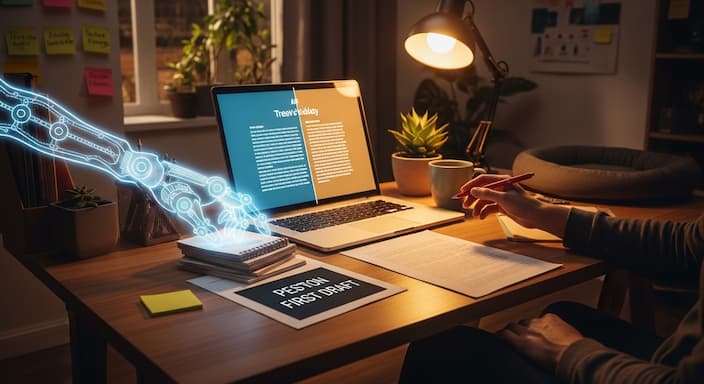
Let’s be honest for a second. When you first heard about the latest wave of AI tools, what went through your head?
If you’re a freelancer—a writer, a designer, a coder, a consultant—there’s a good chance your stomach dropped a little. You probably wondered if this was the beginning of the end. Will clients still need me if a robot can do it faster and cheaper?
I had that same panic. I stared at the screen, watching an AI generate a blog outline in five seconds that would have taken me twenty minutes of brainstorming. It felt personal.
But here’s what I’ve realized since then, after the panic subsided and the experimentation began: AI isn’t here to replace you. It’s here to make you unstoppable.
Think of it this way: The calculator didn’t replace mathematicians. It just meant they didn’t have to do long division by hand anymore. It freed them up to focus on the complex theories.
For freelancers, AI is your calculator. It’s the assistant you couldn’t afford to hire. It’s the tool that lets you stop doing the grunt work and start thinking like a full-blown agency. Freelancing with AI tools isn’t about becoming obsolete; it’s about becoming a one-person powerhouse.
Let’s talk about how you actually do that.
Why “Faster” is the Wrong Goal
A lot of freelancers make a critical mistake when they first start using AI. They use it to work faster, and then they charge the same amount.
If you can write a blog post in two hours instead of four, and you charge a flat rate of $500, congratulations—you just doubled your hourly rate. That’s great for you. But eventually, clients will catch on. They’ll realize the work is getting done quicker, and they’ll start asking for discounts.
That’s a race to the bottom you don’t want to run.
The real power of AI isn’t just speed. It’s capacity and quality.
Instead of using the extra two hours to go play golf (though, hey, treat yourself sometimes), use that time to offer more value to the same client. If you’re a copywriter, use AI to generate five different headline variations for the blog post and A/B test them. If you’re a graphic designer, use AI tools to quickly mock up three different concepts for a logo instead of one.
You’re no longer just a writer. You’re a writer plus a junior strategist. You’re a designer plus a rapid prototyping machine. You’re giving the client a better product and a deeper service. That’s how you raise your rates without anyone batting an eye.
The “Blank Page” Problem is Solved
Every creative knows the terror of the blank page. You have a deadline looming, a cup of coffee getting cold, and a cursor just blinking at you mockingly. Getting started is often the hardest part of the job.
This is where AI shines as a brainstorming partner.
I’m not talking about asking AI to write the final draft. That almost always results in generic, soulless sludge. But asking it to help you start? Game changer.
Let’s say you’re a freelance social media manager for a local bakery. You need 30 days of Instagram captions, and you’ve got nothing. You can prompt an AI tool: “Give me 20 content ideas for a bakery Instagram account. Focus on behind-the-scenes moments, customer stories, and baking tips.”
In ten seconds, you have a list. Some ideas will be duds. But one or two will spark something. “Oh, I love the idea of ‘The 7 AM vs. 7 PM Baker’—I can totally film that today.”
The AI didn’t do your job. It just killed the blank page for you. It got the wheels turning so you could focus on the fun part: creating something human and engaging.
Leveling Up Your Weak Spots
As a freelancer, you are a generalist wearing a specialist’s hat. You might be a brilliant web developer, but you hate writing the “About Us” copy for the sites you build. Or maybe you’re a fantastic copywriter, but you can’t design a landing page to save your life.
Traditionally, you had two choices: outsource the work (which eats into your profit) or just do a mediocre job yourself.
AI tools are changing that. They act as a bridge across your skill gaps.
-
The Designer Who Can Code: If you’re a visual person but get lost in syntax, you can use AI to generate code snippets for a simple email template. You describe what you want in plain English, and the AI spits out the HTML. You tweak the colors, and suddenly you’re a designer who can also “code.”
-
The Writer Who Needs Visuals: If words are your game but you need a hero image for a blog post, you can use an AI image generator. Type in “a cozy home office with a cat sleeping on a stack of books, warm lighting, photorealistic,” and you’ve got a custom image that doesn’t cost you a stock photo subscription fee or a designer’s hourly rate.
This doesn’t mean you should pretend to be something you’re not. But it does mean you can package your services in a more complete way. You can offer a “Website Launch Package” that includes the dev work and the initial copy, because you have an AI tool handling the first draft of the words.
The Pitch That Wins Every Time
Here’s a secret about clients: they are terrified of the unknown. When they hire you, they are taking a risk. They are spending money and hoping for a result.
One of the hardest parts of freelancing is the pitch. You have to convince someone that you understand their problem and have the solution, usually without doing any actual work for them yet.
AI gives you a superpower here: the ability to create a “proof of concept” instantly.
Imagine you’re pitching a content marketing package to a local real estate agent. Instead of sending a boring PDF proposal, you do this:
-
You ask the agent for a link to their latest listing.
-
You feed the listing details into an AI tool and ask it to generate five different “vibes” for a social media campaign: one for luxury buyers, one for first-time homebuyers, one for investors.
-
You use a free design tool to quickly mock up those social posts with the AI-generated copy and some stock photos.
You go to the meeting and you don’t just tell them you can help. You show them. “Here is exactly what your content could look like for three different audiences.”
That level of specificity is impossible to ignore. You look like a mind reader, and you look like you’ve already started working for them. It builds trust faster than any “About Me” page ever could.
But Isn’t It Cheating?
I hear this question a lot. And I understand the sentiment. There’s a fear that using AI makes you less authentic, or that you’re taking a shortcut.
Here’s my take: Is a chef cheating if they use a food processor instead of chopping everything by hand? Is a carpenter cheating if they use a power drill instead of a manual screwdriver?
Tools evolve. The end result is what matters to the client. They don’t care if you wrote the headline yourself or if an AI helped you brainstorm it. They care if the headline makes people click the “Buy Now” button.
The ethics of this are simple: you are the editor-in-chief. You are the quality control. You are the taste-maker.
AI can generate a thousand variations of a logo, but it can’t tell you which one feels like the brand’s soul. AI can write a 1,000-word article, but it can’t fact-check it with your personal industry experience.
You are the human in the loop. You are the one with the taste, the empathy, and the judgment. The AI is just a tool to execute your vision faster.
How to Start Without Overwhelming Yourself
If you’re reading this and thinking, “Okay, I’m convinced, but where do I even begin?”—start small. Don’t try to rebuild your entire workflow overnight.
Pick one task you dread. The one that makes you procrastinate. Maybe it’s writing email subject lines. Maybe it’s coming up with hashtags. Maybe it’s outlining long reports.
For one week, use an AI tool just for that one task.
-
Week 1: Use it only for email subject lines.
-
Week 2: Use it to summarize long client briefs into bullet points.
-
Week 3: Use it to brainstorm content topics for your own marketing.
Slowly, you’ll build a feel for how the tool “thinks.” You’ll learn how to prompt it to get good results, not just generic ones. You’ll learn when to trust its output and when to hit delete.
Before you know it, you won’t think of it as a scary robot stealing your job. You’ll wonder how you ever managed your inbox without it.
The Future is Freelancer-Plus
The market for freelance services isn’t shrinking. It’s evolving. The low-end, repetitive tasks are being automated. But the demand for high-level thinking, creative strategy, and human connection is higher than ever.
The freelancers who will thrive in the next five years aren’t the ones who ignore AI. They’re also not the ones who rely on it completely. They are the “Freelancer-Plus”—the human expert augmented by a machine’s efficiency.
You are the strategist. You are the relationship-builder. You are the one with the taste and the experience. The AI is just your tireless, lightning-fast intern.
So, take a deep breath. Open up one of those tools, and start playing. Your new teammate is waiting.


