Let’s be real. The term “marketing funnel” sounds complicated. It feels like one of those corporate whiteboard words, scribbled next to terms like “synergy” and “paradigm shift.” You know you need one. You’ve seen the diagrams—that wide top, narrowing down to a tiny spout. But when you sit down to actually build one, you’re left staring at a blank screen, wondering what on earth to post first.
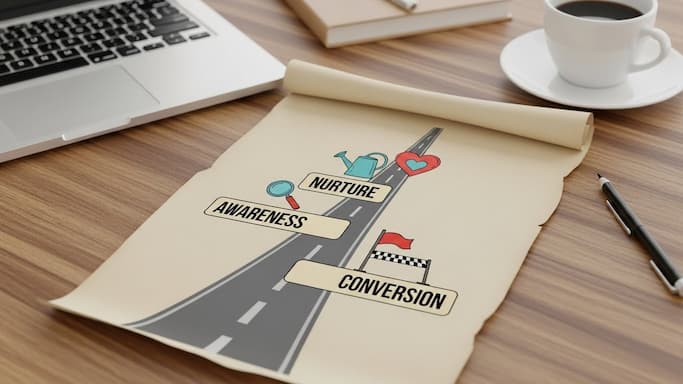
What if I told you that building a simple, effective marketing system isn’t about constructing a rigid funnel? It’s about paving a helpful highway. A place where strangers can find you, take a smooth drive toward a solution, and arrive exactly where they want to go. No pressure. No confusing off-ramps. Just clear directions.
Because at its heart, marketing isn’t about pushing people through a contraption. It’s about guiding someone from their problem (“I’m overwhelmed”) to your solution (“Here’s exactly how to fix that”). And you can build that path today, without fancy software or a decade of experience.
Let’s ditch the confusing jargon and build your marketing highway, one simple lane at a time.
What Your Highway Actually Does (And Why It Works)
Before we lay any asphalt, understand the core job of this system. Its sole purpose is to build a relationship with one person and guide them to a logical next step.
Think of it like meeting someone at a party. You wouldn’t walk up, hand them a business card, and say, “Give me $97.” You’d start a conversation (that’s your free content). If you hit it off, you might swap numbers (that’s them joining your email list). Later, you’d text to grab coffee (that’s your email nurturing). At coffee, if they mention a problem you can solve, you’d offer your help (that’s your paid offer).
Your marketing highway just scales that polite, human conversation. It has three main lanes:
-
The On-Ramp (Awareness): Where strangers discover you.
-
The Scenic Route (Nurture): Where you build trust and prove your value.
-
The Destination (Conversion): Where they happily take you up on your offer.
We’re going to build each lane using things you already understand: content, email, and a simple offer.
Lane 1: The On-Ramp – Answering “What’s That?”
This is where everyone starts. Someone has a question, a frustration, or a curiosity. They go to Google, YouTube, Pinterest, or Instagram and search. Your goal here is to be the best, most helpful answer to that specific search.
Forget selling. Your only job in this lane is to provide incredible free value. We’re talking about the content that makes someone think, “Whoa, this person really gets it.”
-
The Blog Post or Video That Solves a Micro-Problem: Don’t write “The Ultimate Guide to Gardening.” That’s a 300-page book. Write “How to Revive a Drooping Basil Plant in 3 Days.” Specific, helpful, and shows your expertise.
-
The Social Media Post That Connects: Share a quick tip, a relatable struggle, or a before-and-after snapshot. The comment section is your conversation starter.
Your One Simple Task for Lane 1: Identify one tiny problem your ideal customer faces. Create one piece of content that solves it completely. Publish it where they hang out online. That’s your on-ramp.
Lane 2: The Scenic Route – The “You Get Me” Email List
Here’s the critical pivot most people miss. You don’t want to chase strangers around the internet forever. You want to invite them to continue the conversation in a place you own: your email list.
Your on-ramp content should include a simple, valuable invitation to join you. This isn’t a desperate “SIGN UP FOR MY NEWSLETTER!” plea. It’s a natural next step in being helpful.
This is your lead magnet or freebie. It’s a direct extension of the help you just provided.
-
Example: If your blog post was “How to Revive a Drooping Basil Plant,” your freebie could be a “Herb Care Cheat Sheet” PDF or a short video workshop on “The 5 Most Common Herb-Killing Mistakes.”
-
The Trade: They give you their email address. You give them a concentrated dose of value. It’s a fair exchange.
Once they’re on your list, the scenic route begins. You send regular, helpful emails. Not just “buy my stuff” blasts, but notes that teach, encourage, and share stories. This is where trust is built, over days and weeks. You’re proving you’re consistent, knowledgeable, and genuinely in their corner.
Lane 3: The Destination – The Natural “Next Step”
After you’ve provided free value (Lane 1) and built trust over email (Lane 2), making an offer isn’t salesy. It’s the logical conclusion.
Your offer is simply a more complete, in-depth, or hands-on solution to the bigger problem behind all those tiny problems you’ve been helping with.
-
The Analogy: Your free blog post (Lane 1) taught them how to change a flat tire. Your freebie (Lane 2) was a diagram of under-the-hood components. Your paid offer (Lane 3) is a full car maintenance course, or you offering to be their on-call mechanic.
-
The Offer Itself: Keep it simple to start. A single digital product (an ebook, a short course), a one-on-one consultation call, or a simple service package. Don’t build a complex suite of offers. Build one excellent solution.
When you present this offer in an email, it feels natural. You’re saying, “You’ve been learning about X with me. If you’re ready to solve this completely, here’s the proven path.” It’s a service, not a pitch.
Your Simple, 4-Piece Highway Framework
Let’s make this absurdly tangible. Here’s your complete, working system:
-
The Free Content Piece (The Billboard): “How to [Solve Micro-Problem].” Published on your blog/YouTube.
-
The Irresistible Freebie (The Invitation): A deeper resource on the same topic, given in exchange for an email address. A cheat sheet, a template, a mini-course.
-
The Nurture Sequence (The Trust Builder): A series of 3-5 automated emails that deliver more value, tell your story, and warmly introduce your…
-
The Core Offer (The Destination): Your single, clear, paid product or service that provides the ultimate solution.
That’s it. You don’t need more layers. You need to make these four pieces excellent and connected.
Start Driving Traffic (Paving Your On-Ramp)
A highway with no cars is just a strip of pavement. You need to attract drivers to your on-ramp. Focus on one or two methods to begin.
Answer Questions: Use a free tool like AnswerThePublic or just think about your own struggles. What did you search for when you started? Write that content.
Be Consistently Helpful: Show up in one social media community or platform and be genuinely useful. Don’t just post links to your blog. Answer questions in the comments. Share snippets of your knowledge.
The Long Game: This highway is built for longevity. That blog post you write today can attract new strangers for years. That lead magnet can build your list while you sleep. You’re not chasing trending sounds; you’re building a permanent, helpful roadside attraction.
The Only Upgrade You Need: Paying Attention
You don’t need complex analytics to start. Just pay attention to simple signals. Is one blog post getting more traffic than others? That’s a sign people want that topic—create more content like it and a freebie to match. Are people opening your emails? That means your subject lines are working. Is one type of email getting clicks? Write more of that style.
Your marketing highway isn’t a set-it-and-forget-it machine. It’s a living system you tune up by observing what your audience responds to. Start simple, be genuinely helpful, and guide people step-by-step. That’s how you build a marketing system that doesn’t just generate leads—it builds a community that trusts you enough to take the journey all the way to the destination.
Ready to lay your first mile of asphalt? Don’t overthink it. Today, just define your four pieces:
-
What’s one micro-problem you can write a blog post about?
-
What’s a super helpful PDF or video you can give away on that topic?
-
What’s the first helpful email you’d send after someone downloads it?
-
What’s the one paid result you help people achieve?
Sketch that out. You’ve just designed your highway.