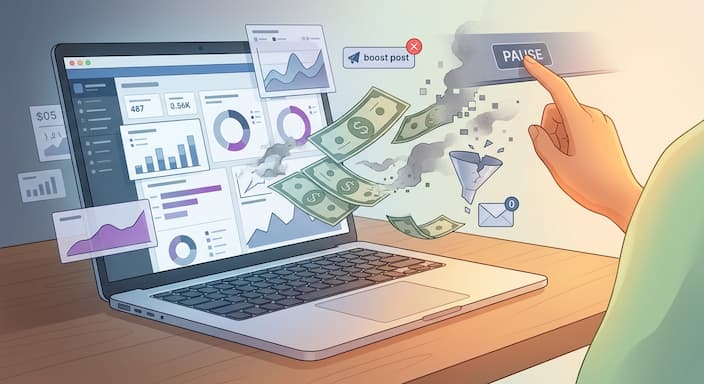
You know that feeling. You’ve just published a blog post, launched a product, or updated your website. Then you hit refresh. And refresh again. You’re waiting for the dopamine hit of traffic, the ping of a sale, the instant validation that what you built actually matters.
But the inbox stays quiet. The analytics look flat. And a little voice whispers: This isn’t working.
It’s the worst feeling in the world. It makes you want to pivot, to chase the shiny new tactic everyone on Twitter is hyping, or to slash your prices just to get a reaction.
I get it. We’ve all been there. But here is the hard truth that separates the people who build lasting wealth online from those who burn out after six months: If you optimize only for the next 24 hours, you guarantee mediocrity for the next 24 months.
The internet is a fickle beast. Algorithms change, trends die, and attention spans shrink. But there is one strategy that insulates you from all that chaos. It’s boring, it’s unsexy, and it doesn’t work overnight. But when it clicks? It’s unstoppable.
Let’s talk about why long-term thinking isn’t just a nice philosophy—it’s the only real business model that pays off online.
The “Get Rich Quick” Trap Is a Lie We Love to Believe
We are biologically wired to seek instant rewards. If our ancestors saw a berry bush, they ate the berries now because they didn’t know if they’d find food tomorrow. That instinct hasn’t left us; it just migrated to our browsers.
We see a course promising “10K in 10 Days” or a hack to “Go Viral on TikTok Overnight,” and our brains light up. It promises to solve the anxiety of uncertainty right now.
But here is the problem with hacks: they expire.
If you build your house on rented land (a social media algorithm you don’t own), the landlord can evict you whenever they want. If you rely on viral gimmicks, you have to constantly one-up yourself with a louder, crazier stunt just to stay in place. It’s exhausting. It’s a treadmill that slowly speeds up until you fly off the back.
Short-term thinking feels productive because it keeps you busy. But busy is not the same as effective.
Compound Interest: The Magic That Happens While You Sleep
You’ve probably heard of compound interest in the context of money. You invest a little, it earns interest, and then that interest earns interest. Over decades, a small pile becomes a mountain.
The exact same principle applies to content, authority, and relationships.
When you write a blog post today, it might get ten views. But if that post answers a question someone has, and they bookmark it, and they link to it, and Google realizes it’s helpful, that post works for you tomorrow, and next month, and next year.
I call this “Content Compounding.”
Every long-term asset you build—whether it’s a YouTube video, a podcast episode, or a detailed guide—is a seed. You water it once (by publishing it), and over time, it grows roots. It attracts backlinks. It builds topical authority. It tells Google, “Hey, this person knows what they’re talking about.”
In five years, that “slow” strategy means you have 500 pieces of content working for you 24/7. The person chasing hacks? They’re starting from zero every single morning, trying to figure out what the new trend is.
Owning Your Audience vs. Renting Attention
There is a massive difference between having followers and having a community.
If you have 100,000 followers on a platform, you don’t actually own that relationship. The platform does. They decide who sees your posts (usually less than 2% of your audience). They can shadow-ban you. They can go bankrupt or change their terms of service overnight.
Long-term thinking is about owning your real estate.
This is why building an email list, or a forum, or a loyal readership on a website you control is the ultimate long game. It’s slower to build because you have to earn someone’s trust enough that they want to hear from you directly.
But once you have that direct line? It’s gold.
When you launch a product, you don’t have to pray to the algorithm gods. You just talk to your people. Those people stick with you through platform changes. They follow you because they trust you, not because a robot showed them your face once.
Trust Is the Only Currency That Never Devalues
Let’s look at the math of a customer.
-
Scenario A (Short-term): You run a Facebook ad to a cheap product. Someone buys it because the ad was flashy. They get the product, it’s mediocre, and they never buy from you again. You spent $50 to acquire them, made $40, and lost money. You have to find a new person tomorrow.
-
Scenario B (Long-term): You write an incredibly helpful guide. Someone finds it on Google. They read it for free. They think, “Wow, this person really helped me.” They sign up for your newsletter. A month later, you recommend a tool. They buy it. A year later, you launch a high-ticket course. They buy that too.
That second customer is worth exponentially more than the first. Not just in dollars, but in advocacy. They tell their friends about you.
Trust is fragile—it takes years to build and seconds to break—but it is the only asset that increases in value every single year. You cannot hack trust. You can only earn it, slowly, by consistently showing up and being helpful.
How to Actually Do the Long Game (Without Getting Bored)
Okay, so you’re convinced. Patience pays. But how do you actually implement this when you need to pay the bills this month? It’s a tightrope walk.
You have to balance the urgent with the important. Here is the practical framework:
1. Create “Evergreen” Pillar Content
Stop writing about news that will be irrelevant next week. Write about problems that never go away.
-
Bad: “5 Things Elon Musk Said Yesterday”
-
Good: “How to Overcome Procrastination When Working From Home”
The first piece is dead tomorrow. The second piece is useful forever. Every month, that “boring” article brings in traffic, builds your authority, and can be updated with fresh examples to stay current.
2. Play the 1% Game
You don’t need to be 10x better than everyone else overnight. You just need to be 1% better than you were yesterday.
Publish one article a week instead of zero. Answer one email with genuine care instead of a template. Improve your website speed by half a second.
These small wins stack up. After a year, you aren’t 1% better; you’re 37% better. That’s the compound effect in action.
3. Ignore Your Competitors (Seriously)
When you watch a competitor blow up overnight, it feels like you’re losing. But you’re only seeing their highlight reel. You don’t see the burnout, the fake engagement, or the luck factor.
If you chase what they do, you’ll always be a step behind. If you focus on what you do best, you become the only option. There is no competition for “you.”
4. Build Systems, Not Just Goals
A goal is “I want 10,000 email subscribers.” A system is “I will publish one valuable newsletter every Tuesday, no matter what.”
Goals give you a dopamine hit when you reach them. Systems keep you alive on the days you don’t. Long-term thinking is about falling in love with the systems, because the systems are what get you through the boring middle.
The Plateau of Latent Potential
There is a concept in behavioral change called the “Plateau of Latent Potential.”
Imagine a ice cube sitting on a table. The room is cold. You turn up the heat. Nothing happens. You turn it up more. Nothing. More. Nothing. It feels like a waste of energy. Then, at 33 degrees, one single degree of heat changes everything. The ice melts.
Everything you build online works the same way. You will put in work for months and see nothing. No traffic. No sales. No comments. It feels pointless. But you aren’t failing; you’re heating the room. You’re building the latent potential.
Then, one day, one piece of content catches a wave, or one customer refers ten friends, or Google finally decides you’re an authority. And it all melts at once.
If you quit because you didn’t see results in the first month, you miss the melt.
Your Next Step
The internet is the greatest wealth-building machine in history because of one reason: asymmetry. You can put work in once, and it pays you forever.
But that machine only rewards those who respect the timeline. It punishes the frantic and rewards the patient.
So, take a breath. Stop looking at the analytics dashboard every five minutes. Stop trying to game the system. Start building something that matters.
Write the guide that helps one person. Record the podcast that makes someone feel less alone. Build the tool that solves a tiny, annoying problem.
Do that for a year. Do it for five years.
You won’t just succeed online. You’ll build a life you don’t need a vacation from.