So you’re ready to make real money online. You’ve been in the digital trenches, learning the ropes, and now you’re staring down two massive roads: Social Media Marketing and SEO. The gurus are screaming from both sides. One camp says, “Forget SEO! It’s dead! Build a personal brand on social and monetize your audience!” The other insists, “Social media is a noisy party. Own an asset with SEO and get rich in your sleep.” It’s enough to give you whiplash.
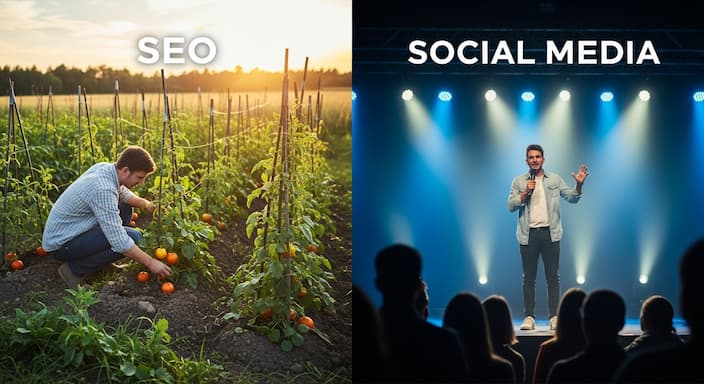
Here’s what no one tells you when you’re just starting out: this isn’t a matter of picking the “right” one. It’s about understanding the fundamental nature of each game. One plays like a fast-paced, high-stakes game of basketball where you score points in real-time. The other is like buying a piece of farmland—it takes a season of hard work before you harvest a crop, but that land can keep feeding you for years.
Your job isn’t to choose a side in a war. It’s to decide which game you’re temperamentally and strategically built to play first, and how you can use the other to support it. Let’s break down the real-world pros, cons, and income potential of each, so you can invest your time where it will actually pay your bills.
The Mindset: Understanding the Core Difference
Before we dive into tactics, you need to understand the essential nature of each channel.
SEO (Search Engine Optimization) is about ownership and intent. When someone types “best ergonomic office chair for back pain” into Google, they have a clear intention. They are in research mode, actively looking for a solution. If your content ranks for that term, you own that traffic. Google can’t suddenly decide to stop showing your website (unless you violate their rules). It’s an asset you build. The trade-off? It’s slow. It can take months of consistent work before you see significant, stable traffic. It’s a long-term investment.
Social Media Marketing is about attention and community. On platforms like Instagram, TikTok, YouTube, or Pinterest, you’re competing for the scrolling user’s fleeting attention. The intent is lower—they’re here to be entertained, inspired, or connected. But the speed is lightning-fast. You can post a video today and have it seen by thousands tomorrow. You build a following, a community of people who know, like, and trust you. The trade-off? You don’t own the platform. An algorithm change can wipe out your visibility overnight. It’s a rented audience, and the rent can go up without notice.
Think of it this way: SEO is your own, mortgage-free house. Social media is a fabulous, high-traffic apartment in a trendy building owned by a unpredictable landlord (Meta, TikTok, etc.). One provides stability; the other provides immediate buzz.
The Income Game: How Each Path Actually Pays You
This is where the rubber meets the road. How does the money flow from each of these strategies?
The SEO Income Model: The Long-Term Engine
With SEO, your primary currency is targeted website traffic. Your income model is typically built on turning that intent-rich traffic into actions:
-
Affiliate Marketing: Recommending products you genuinely believe in and earning a commission on sales.
-
Display Advertising: Placing ads (like Google AdSense or Ezoic) on your content and earning money based on views or clicks.
-
Selling Your Own Products/Services: Using your high-ranking content as a lead generator for your digital course, coaching, or physical product.
The beautiful part? It’s largely passive and cumulative. An article you wrote 18 months ago can rank on page one and send you affiliate commissions every single day, without you lifting a finger. The income from SEO tends to grow steadily over time, like a slow-rising tide that lifts all your articles. It’s predictable and resilient once established.
The Social Media Income Model: The Personal Brand Powerhouse
With social media, your primary currency is influence and direct connection. Your income model is built on leveraging your relationship with your followers:
-
Sponsorships & Brand Deals: Companies pay you directly to promote their product to your audience.
-
Affiliate Marketing (Direct Promotion): Sharing your unique affiliate link in stories, posts, and bios, often leading to faster, high-trust sales.
-
Selling Your Own Products/Services: Launching directly to a warm audience that already loves you.
-
Platform-Specific Funds: Like the YouTube Partner Program or TikTok Creator Fund.
The key characteristic? It’s active and direct. You often need to be constantly creating and engaging to maintain relevance and visibility. A sponsorship deal is a direct deposit for your influence. The income can be more “lumpy”—a big brand deal one month, smaller affiliate income the next. It scales with your personal visibility and engagement.
The Time & Skill Investment: What Does It Really Take?
Let’s be brutally honest about the daily grind.
What SEO Demands of You: Patience is not just a virtue; it’s the entire job description. Your core skills are research, writing for clarity and depth, and basic technical understanding. Your day involves keyword research, writing comprehensive “best answer” content, and building simple site architecture. It’s a marathoner’s game. You might work for 3-6 months before seeing your first meaningful paycheck. But once it starts, it compounds. You need the financial and emotional runway to handle the delayed gratification.
What Social Media Demands of You: Relentless creativity and consistency. Your core skills are being on-camera (or having a compelling visual/audio style), understanding trends, and engaging in real-time. Your day involves filming, editing, writing captions, replying to comments, and planning your next post. It’s a sprinter’s game. You can see results (followers, engagement) in weeks, but you must maintain a frantic pace to keep the momentum. You need to be comfortable in the spotlight and adaptable to constant change.
The Smartest Move: Why “Versus” is the Wrong Question
Here’s the secret the most successful online entrepreneurs use: they don’t choose. They sequence and integrate.
For most people starting from zero, the most powerful strategy is to use social media to fuel your SEO asset.
Here’s what that looks like in practice:
You have a blog (your SEO asset). You write a fantastic, in-depth guide on “How to Start a Vegetable Garden in Small Spaces.” That’s your cornerstone piece, optimized for search.
Then, you go to social media. On TikTok, you post a 60-second video showing the “3 Biggest Mistakes in Small Space Gardening.” In the caption, you say, “I made a free PDF checklist to avoid these! Link in bio.” The link in your bio goes to your blog post, where readers can get the checklist in exchange for their email address.
What just happened?
-
You used social media’s speed and reach to drive targeted traffic to your website.
-
You captured an email address, building an owned audience (even more valuable than social followers).
-
You improved your blog’s engagement metrics, which can subtly help your SEO.
-
Your blog post now has a chance to rank on Google and send you passive traffic for years.
Social media becomes the megaphone for the asset you own. You’re not building on rented land; you’re using the busy street (social media) to invite people into your permanent store (your website).
Your First Move: Playing to Your Strengths
So, where should you start? Ask yourself two questions:
-
What’s your temperament? Are you a patient builder who enjoys deep work and writing? Or are you a creative performer who thrives on immediate feedback and connection?
-
What’s your timeline? Do you have 6+ months to build an asset before needing significant income? Or do you need to generate some cash flow and audience connection in the next 90 days?
If you’re patient and a strong writer, start with SEO. Build your website and create 10-15 fantastic pieces of content before you even think about promoting them heavily. Then, use social media sparingly to amplify your best work.
If you’re creative, personable, and need quicker validation, start with social media. Build a following around your niche. But from day one, use that platform to send people to one central hub—an email list or a simple blog. That way, you’re building a community and an asset simultaneously.
Stop seeing this as an either/or fight. See it as a portfolio. The most reliable online income comes from having both: the stable, long-term dividends of SEO and the active, direct income streams from a trusted social presence. Start with the game that fits you best, but always build with the other in mind. Your future self, enjoying both the reliable checks and the huge paydays, will thank you.